

New Documentary Follows a U.S. Combat Veteran Into Russia's Campaign to Steal Ukraine's Children — and Save Ukraine's Fight to Bring Them Home
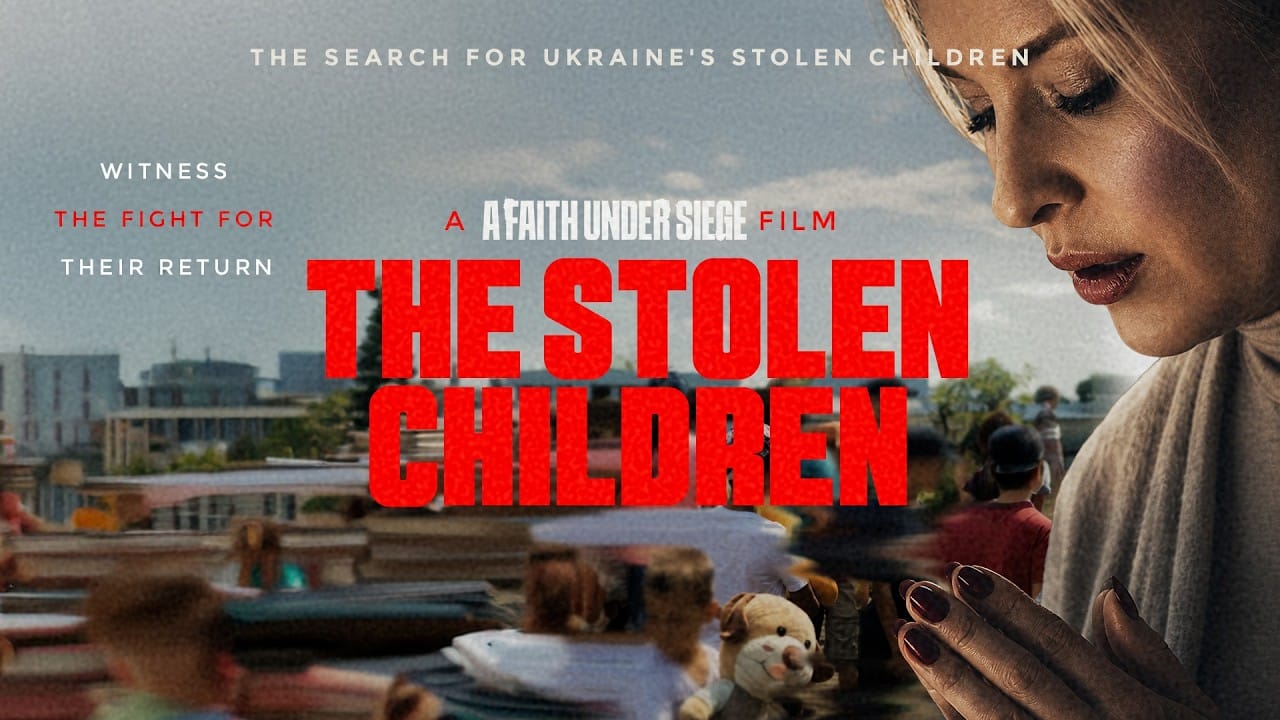
A new film premiering this month puts faces and names to one of the most devastating, least understood consequences of Russia’s war on Ukraine: the systematic abduction of its children. The Stolen Children, a 39-minute episode of the documentary series Faith in War, premiered August 2 on the official A Faith Under Siege YouTube channel, with the full five-part series arriving on TBN+ August 6.
The episode follows Meaghan Mobbs — a combat veteran, West Point graduate, and president of the Romulus T. Weatherman Foundation — as she travels to Ukraine to find out whether reports of mass child abduction could possibly be true. “I remember being skeptical,” Mobbs says in the film. “We can’t possibly be allowing thousands of children to be stolen. That seems ludicrous.” What she finds instead is a documented, deliberate system.
A system built to erase a generation
Ukraine has documented, name by name, more than 19,000 children deported or forcibly transferred by russia since the full-scale invasion began — a figure officials and researchers believe significantly understates the true number. Children are taken from filtration camps, hospitals, and occupied towns. Their birth certificates and documents are altered. Their language is forbidden. Some are placed with Russian families and told their parents no longer want them; others are sent to “re-education” facilities or military training programs intended, in the words of one investigator in the film, to turn them into “a new generation of Russian soldiers.”
In March 2023, the International Criminal Court issued arrest warrants for Vladimir Putin and Russia’s children’s rights commissioner, Maria Lvova-Belova, specifically for the unlawful deportation of Ukrainian children — an act enumerated as genocide under Article II of the 1948 Genocide Convention. Researchers at Yale University’s Humanitarian Research Lab have mapped a network of camps and facilities across Russia and occupied territory built to hold them.
The Stolen Children puts firsthand testimony behind those numbers: a boy pulled out of occupied Donetsk by his grandmother after losing his mother to Russian shelling; a 17-year-old tortured for organizing a resistance cell; a teenage girl taken to a Crimean “recreation camp” and cut off from her family for two years. “The world needs to finally know what is happening here,” one of them tells Mobbs. “I just hope that when the world understands, everything will be fine.”
Save Ukraine, on screen and on the ground
Mobbs doesn’t investigate alone. Throughout the film, she works alongside government officials, human rights investigators, and our own rescue teams — the frontline missions that go into Russia and occupied territory to locate stolen children and bring them home. Our founder, Mykola Kuleba, Ukraine’s former Presidential Commissioner for Children’s Rights, appears among the film’s investigators and advocates, describing a system built specifically to make stolen children nearly impossible to trace: falsified documents, changed names, and a Russian government that refuses to share information with Ukrainian authorities.
That’s the gap we exist to close. Since 2014, we’ve coordinated the only full cycle of support for Ukraine’s stolen children — from rescue operations inside Russia and occupied territory, through document restoration and family reunification, to long-term trauma recovery and reintegration. To date, we’ve rescued 1,843 children from Russia and temporarily occupied territories, alongside sheltering and supporting thousands more families displaced by the war.
Why now
The film arrives at a pointed moment. As producer Steven Moore, a former congressional chief of staff, says in the film’s press materials: “The return of every stolen child must be a non-negotiable condition of any peace.” With ceasefire and settlement talks an ongoing part of the news cycle, The Stolen Children argues that any resolution to the war that doesn’t account for these children leaves the crime unresolved — and the clock still running. “Every day these children remain in Russia,” the filmmakers note, “they are being renamed, re-educated, and stripped of who they are.”
Producer Colby Barrett, a former U.S. Marine Corps captain and father of four, called it the hardest film he’s made: “When you sit across from a kid who escaped that and hear their story firsthand, you can’t unhear it. My prayer is that Americans who watch this ask the question the film asks: if these were our children, what would we do?”
The Stolen Children is streaming now on YouTube via the official A Faith Under Siege channel, with the full Faith in War series available on TBN+ starting August 6. Learn more at faithinwar.com/stolen-children.
Watch the film. Then help finish the story it tells. Our rescue teams are still working, week after week, to locate and bring home children like the ones featured in this film.
You can share the post: